 How-to
How to Book a Land Clearing Site Assessment Before You Build
Last Updated: October 26, 2026
Quick Summary
Book a land clearing site assessment by defining your end goal, gathering your deed, plat, and utility records, then contacting two or three contractors to schedule an on-site walkthrough. Meet on site, walk the property line together, and compare written scopes rather than phone quotes. Booking by phone quote alone is the most common and most expensive mistake.
- A site assessment documents vegetation, ground conditions, boundaries, utilities, and permit triggers.
- The written report should include a work area map, vegetation lists, access routes, and exclusions.
- Compare proposals on acreage basis, stump treatment, debris disposal, matting, and erosion control.
- Ask contractors about insurance, scope, stump and debris handling, damage liability, and permits.
- Palmetto Mulching & Clearing is an SBA Certified Veteran Owned Business serving SC, NC, and GA.
Table of Contents
- What a Land Clearing Site Assessment Covers
- How to Book a Land Clearing Site Assessment in Five Steps
- Your Land Clearing Checklist: Documents and Details to Have Ready
- What Drives a Land Clearing Estimate and How to Read One
- Land Clearing Contractor Questions to Ask Before You Sign
- Environmental, Erosion, and Stormwater Constraints on Your Site
- Schedule Your Site Assessment with Palmetto Mulching & Clearing
- Frequently Asked Questions
What a Land Clearing Site Assessment Covers
Booking a land clearing site assessment is the step that decides whether your build starts on time or stalls in month three. At Palmetto Mulching & Clearing, LLC, we treat this visit as the foundation of every project, not a formality.
Most property owners skip it. They call three companies, take a phone quote, and pick the lowest number. Then the crew arrives, finds a spring-fed wet spot and a buried septic line, and the price changes. Here is how to avoid that.
The visit covers far more than counting trees:
- Vegetation inventory: trees, brush, vines, and invasive growth, plus which specimens are worth saving
- Ground conditions: soil type, slope, wet areas, and load-bearing capacity
- Boundaries and access: where the property line runs and how equipment reaches the work area
- Utilities and obstacles: buried lines, fences, structures, and debris
- Constraints: drainage patterns, erosion risk, and any permit triggers
Land Clearing vs. Site Preparation: Why the Visit Comes First
Land clearing removes what is on the land. Site preparation shapes what remains so construction can begin. Clearing takes out trees, brush, stumps, and debris. Site preparation follows with grading, leveling, drainage work, and building pads.
The assessment has to happen before either one, because you cannot price removal until you know what you are removing.
That is the part most quotes get wrong. A per-acre number quoted over the phone assumes average conditions. Your property is not average.
What the Written Deliverable Should Include
Ask for the findings in writing. A useful assessment report gives you:
- A map or sketch of the work area with boundaries marked
- A list of vegetation to remove and vegetation to protect
- Notes on soil, slope, and wet areas
- Utility locations and any verification still needed
- Access routes for equipment
- A scope of work with quantities, not just a lump sum
- Exclusions, so you know what the price does not cover
If a contractor will not put the scope in writing, that is your answer about how the project will go.
How to Book a Land Clearing Site Assessment in Five Steps
Booking a land clearing site assessment takes five steps: define your goal, gather your documents, contact contractors, schedule the walkthrough, and compare written scopes. Most homeowners finish the first two in an evening.
Step 1: Define the end goal. Know what the land becomes.
Step 2: Gather your documents. Pull the deed, the plat or survey, any prior site plans, and utility records.
Step 3: Contact two or three contractors. Describe the acreage, the vegetation, and the goal. Ask what they need to prepare and how soon they can visit. Expect scheduling to depend on season and workload.
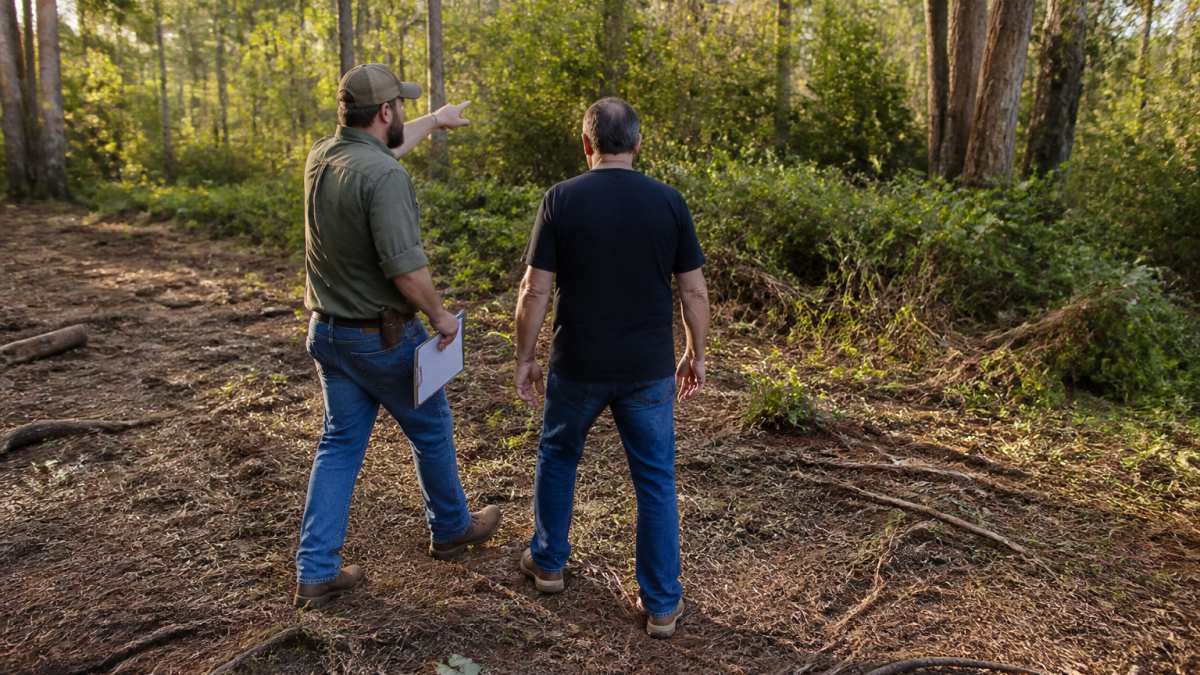
Step 4: Schedule the walkthrough. Meet on site. Walk the property line together.
Step 5: Compare written scopes. Line up the proposals side by side. Compare quantities, exclusions, and disposal methods, not just the total.
Watch out: booking by phone quote alone is the most common and most expensive mistake.
Booking a site assessment follows a short, repeatable sequence you can start in a single evening.
| Step | What to do | Key detail |
|---|---|---|
| 1 | Define the end goal | House pad, driveway, pasture, pond, or right of way |
| 2 | Gather your documents | Deed, plat or survey, prior site plans, utility records |
| 3 | Contact two or three contractors | Describe acreage, vegetation, and goal; ask what they need |
| 4 | Schedule the walkthrough | Meet on site and walk the property line together |
| 5 | Compare written scopes | Compare quantities, exclusions, and disposal methods, not totals |
Your Land Clearing Checklist: Documents and Details to Have Ready
A land clearing checklist saves a return trip. Contractors who arrive to a prepared owner can usually quote faster and more accurately. Have these ready before the visit:
- Deed and legal description
- Plat or boundary survey with corners marked
- Construction plans or a sketch of the intended use
- Utility locate tickets or records of prior locates
- Any prior site work, grading, or fill history
- Locations of wells, septic systems, and drain fields
- Fence lines and shared boundaries with neighbors
- Trees or features you want protected
- Access notes: gates, easements, weight limits on driveways
- Photos of wet areas or problem spots
Also write down your questions. The visit moves fast, and a list keeps you from forgetting the one that mattered.
What Drives a Land Clearing Estimate and How to Read One
A land clearing estimate is a priced scope of work, not a single number. Read it line by line. The total tells you little; the components tell you everything. Two bids for the same acreage can differ by thousands of dollars because one includes stump removal and debris hauling and the other does not.
Expect these line items:
- Acreage and density: thick brush and mature timber cost more per acre than open pasture
- Stump and root removal: grubbing out roots is separate work from felling trees
- Debris handling: mulching in place, hauling off, or burning each carries a different cost
- Terrain: slope, rock, and wet ground slow equipment and raise the price
- Access: a long, narrow entry or a soft driveway may need mats or a different machine
- Grading and drainage: shaping the site after clearing is often a separate line
- Erosion control: silt fence, seeding, and stabilization may be required
Read the exclusions carefully. "Clearing only" means stumps stay. "Grubbing" means roots come out. Those are different jobs with different prices.
How to Compare Two Proposals Side by Side
Put the proposals in the same order and check each line:
- Acreage basis. Does each bid price the same area? One may exclude a buffer or a wet corner.
- Stump treatment. Is it cut flush, ground, or grubbed? Flush-cut stumps are cheaper but leave roots to rot and settle.
- Debris. Mulched in place, hauled to a landfill, or burned on site? Disposal method drives both cost and schedule.
- Access and mats. Is matting for soft ground included or billed as an extra?
- Erosion control. Is silt fence and stabilization in the base price or an allowance?
- Exclusions. What happens if rock, buried debris, or a spring is found?
A bid that explains its math is easier to trust than one that does not. If a line is vague, ask the contractor to break it down before you sign.
Where Land Clearing Cost per Acre Comes From
Land clearing cost per acre varies widely because the inputs vary widely. Density, terrain, stump removal, debris disposal, and access all move the number, which is why a per-acre figure quoted without a site visit is unreliable. The same acre can cost very differently depending on what is growing on it and what is under it.
Ask each contractor to break the price down by these factors. For current pricing on your property, request a quote directly rather than relying on a generic per-acre figure.
Land Clearing Contractor Questions to Ask Before You Sign
Land clearing contractor questions should cover insurance, scope, disposal, and timeline before any signature. Ask them on site, and write down the answers.
- Are you insured, and can I see a certificate of insurance?
- What exactly is included, and what is excluded?
- How will you handle stumps and debris?
- What happens if you damage a fence, driveway, or utility line?
- How will you protect trees and areas I want to keep?
- What is the schedule, and what could delay it?
- Who handles any required permits or erosion control?
- How do you handle wet ground or difficult access?
A common mistake is choosing on price alone. The cheapest bid often excludes stump removal or debris hauling, and those costs return later. A veteran-owned firm like Palmetto Mulching & Clearing, LLC brings accountability to that conversation: we walk the property, document the scope, and put it in writing.
Environmental, Erosion, and Stormwater Constraints on Your Site
Erosion and stormwater rules shape what a crew can do and when. Disturbing soil exposes it to rain, and runoff carries sediment into streams and ditches. Many jurisdictions require an erosion and sediment control plan before ground is broken, and some require permits for larger disturbances.
Ask your contractor how they will handle:
- Silt fence and other sediment barriers
- Stabilization of disturbed areas after clearing
- Protection of drainage ways and buffers
- Timing around wet seasons
Check with your local building department on what your project triggers. Requirements vary by state and county, and the assessment is the right time to identify them. For official guidance on stormwater and construction runoff, see the EPA stormwater program.
Schedule Your Site Assessment with Palmetto Mulching & Clearing
The assessment is the cheapest part of the project and the one that prevents the expensive surprises. Get it right, and the clearing, grading, and site work line up behind a scope you actually understand.
Palmetto Mulching & Clearing, LLC is an SBA Certified Veteran Owned Business, owned and operated by a retired Marine Corps veteran, serving South Carolina, North Carolina, and Georgia.
We take on residential and commercial work alike, and we document the scope before the first machine moves.
Frequently Asked Questions
What should I expect during a land-clearing site assessment?
Expect a walk of the property with the contractor to look at vegetation density, tree size, ground conditions, wet spots, and access for equipment. They will check property boundaries and note any utilities, fences, or structures to protect. You should leave with a written scope describing what will be removed, how debris will be handled, and what the finished ground will look like. Ask for the deliverable in writing so the land clearing scope is clear before any work is scheduled.
How do I prepare my property for a land-clearing assessment?
Walk the property beforehand and note wet areas, old stumps, fence lines, and anything you want kept. Gather your survey, plat map, and any construction plans. Clear a path to the work area so the assessor can reach the back of the lot. If you know where the septic, well, or underground utilities run, mark them or have them located. A short land clearing checklist of documents and site notes saves a second visit and speeds up the estimate.
How much does it cost to clear one acre of land?
Land clearing cost per acre depends on vegetation density, tree size, terrain, access, and how debris is handled. Your land clearing estimate should itemize clearing, disposal, grading, and any erosion control separately so you can compare proposals on the same basis rather than on one lump sum.
What land clearing contractor questions should I ask before hiring?
Ask for proof of insurance and how damage to fences or a neighbor's property is handled. Confirm whether the crew is employees or subcontractors, and ask what equipment will be used and whether it can reach wet or tight areas. Get the scope, timeline, and debris disposal method in writing. Ask whether permits or erosion control measures are required by the local building department. Also ask how they handle protected trees and whether stump grinding is included or billed separately.
Your land is the biggest asset on the project, and the assessment is how you protect it. Palmetto Mulching & Clearing, LLC brings forestry mulching, full site preparation with excavation and grading, and professional pond construction to every job, backed by a written scope and a veteran-owned commitment to doing it right. Get started with Palmetto Mulching & Clearing, LLC and schedule a site assessment that gives you a clear plan and a firm number.