 How-to
How to Clear Land on Wet Soil Without Causing Damage
Last Updated: November 10, 2026
Quick Summary
Land clearing on wet soil should only proceed when soil moisture is low enough that structural damage and compaction are minimized. Test the ground first: if a handful of soil holds together in a tight ball that will not crumble, it is too wet for heavy equipment and work should be postponed.
- A common working window is 48 to 72 hours of dry weather after significant rain, though clay may need a week or more.
- Tracked machines usually lower ground pressure and rut less than wheeled machines on soft ground.
- Score each zone as go, partial, or no-go, and postpone if the primary access route fails.
- Leave vegetation buffers along waterways and install silt fence downslope of disturbed ground.
- Compact ground may need tillage, aeration, or added organic matter before it supports healthy growth.
Table of Contents
- Can You Clear Land When the Soil Is Wet?
- How to Tell If Soil Is Too Wet to Work
- Working on Wet Soil With Heavy Equipment: What Goes Wrong
- How Long Soil Takes to Dry After Rain
- Equipment Access, Routes, and Staging Area Readiness
- Erosion and Sediment Control During Land Clearing
- Partial Work or Full Postponement: A Go/No-Go Decision
- Schedule a Wet-Soil Site Assessment With Palmetto Mulching & Clearing
- Frequently Asked Questions
Can You Clear Land When the Soil Is Wet?
Sometimes you can. Often you should not.
The USDA Natural Resources Conservation Service field standard is clear on the principle: clearing should happen when soil moisture is low enough that structural damage and compaction are minimized.
Pushing through wet ground anyway costs the landowner far more than a short delay.
Below, this guide breaks down how to read soil conditions, what heavy equipment does to saturated ground, and how to decide between partial work and a full postponement.
How to Tell If Soil Is Too Wet to Work
If a handful of soil holds together in a tight ball that will not crumble, it is too wet for heavy equipment. That single test tells you more than a dry-looking surface ever will.
Soil moisture is the deciding factor, not appearance. A crusty top inch can hide saturated clay underneath. Watch for these signs before you schedule anything:
- Standing water or shiny patches in tire ruts
- Boots sinking more than an inch with each step
- Soil that smears instead of crumbling when squeezed
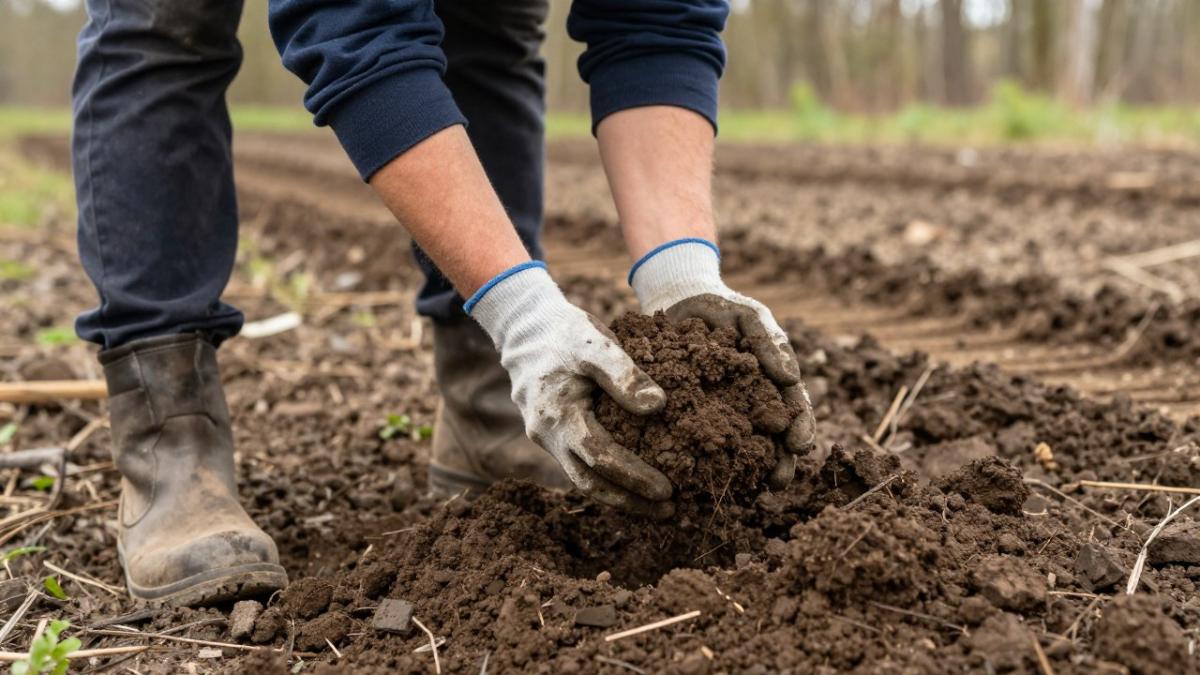
Field Tests You Can Run Before Equipment Arrives
You do not need a lab to judge workability. Three quick checks give you a working answer, but the interpretation depends on soil type and the machine you plan to run.
- The ball test. Squeeze a handful of soil. If it holds shape and leaves moisture on your palm, it is too wet for most tracked machines. Sandy loam may crumble and still be marginal for a heavy wheeled loader.
- The ribbon test. Roll a wet sample between your fingers. Clay that forms a ribbon longer than about two inches is holding too much water. A short, crumbly ribbon suggests better drainage.
- The poke test. Push a rod or stake into the ground. If it slides in with almost no resistance, the subsoil is saturated. Resistance that feels firm but not brick-hard is usually workable for low-ground-pressure equipment.
Run all three in several spots. Low areas and shaded ground dry last, and those are exactly the places equipment gets stuck.
A Site-Wide Go/No-Go Inspection Checklist
A single handful of soil is not a site assessment. Walk the property in the order equipment will travel and score each zone before anyone cranks an engine. This checklist turns the field tests into a repeatable decision:
- Access route: Is the driveway or gate approach firm enough for the heaviest machine? Look for existing ruts, soft shoulders, and culverts that may be saturated.
- Work zones: Test soil at the entrance, the center, and the far corner of each clearing area. A dry entrance tells you nothing about the back acre.
- Staging area: Will the staging pad hold the weight of equipment and debris piles without sinking? Choose the highest, best-drained ground available.
Score each zone as go, partial, or no-go. If any zone on the primary access route is no-go, the whole job usually waits, because equipment cannot reach the work area without crossing it.
Watch out: testing only the surface at the staging area is a common mistake. Push a rod or dig a small hole to check subsoil moisture where heavy equipment will sit for hours.
Why Soil Type Changes the Answer
Acceptable moisture and bearing capacity vary by soil and machine, so there is no universal pass/fail number. Clay holds water and compacts easily; sand drains fast but loses strength when saturated; silt sits between the two and is prone to rutting. A test result that is fine for a tracked skid steer may be unsafe for a loaded dump truck.
Working on Wet Soil With Heavy Equipment: What Goes Wrong
Heavy equipment on wet ground does not just make a mess. It changes the soil itself, and some of that damage lasts for years.
The NRCS guidance warns that rough pushing under wet conditions can cause deep rutting and bury debris, which complicates cleanup later. Iowa State University Extension notes that heavy tractors can drive compaction in wet soil. A machine that seems to float on top is still pressing down with its full weight.
Compaction, Rutting, and Soil Structure Loss
Soil structure is the way soil particles clump together to leave space for air and water. Wet soil loses that structure fast under load.
- Compaction squeezes the air pockets out, so roots and water cannot move freely.
- Rutting cuts deep channels that hold water and redirect runoff.
- Smearing seals the surface and slows drainage further.
The fix is not quick. Compacted ground may need tillage, aeration, or added organic matter before it supports healthy growth or a stable building pad. That is money spent fixing a problem nobody planned for.
How Long Soil Takes to Dry After Rain
There is no universal drying time. A common working window is 48 to 72 hours of dry weather after significant rain, but soil type, drainage, slope, and season can stretch that to a week or more.
Clay soil and poorly drained soil hold water the longest. Sandy, well-drained ground may be workable a day after rain.
Track three things rather than guessing:
- Rainfall totals from the nearest gauge
- Soil moisture using the ball and poke tests
- Dry weather forecast for the next several days
Recheck the ground the morning work is scheduled. A dry entrance tells you nothing about the back acre.
Equipment Access, Routes, and Staging Area Readiness
The route matters as much as the work area. Equipment must travel to, turn, operate at, and leave the site, and every one of those steps can sink a machine on soft ground.
Walk the full path before the crew arrives. Check:
- Gate openings and driveway bearing strength
- Culverts and low crossings that hold water
- Turnaround space at the work area
Tracked vs. Wheeled Equipment on Soft Ground
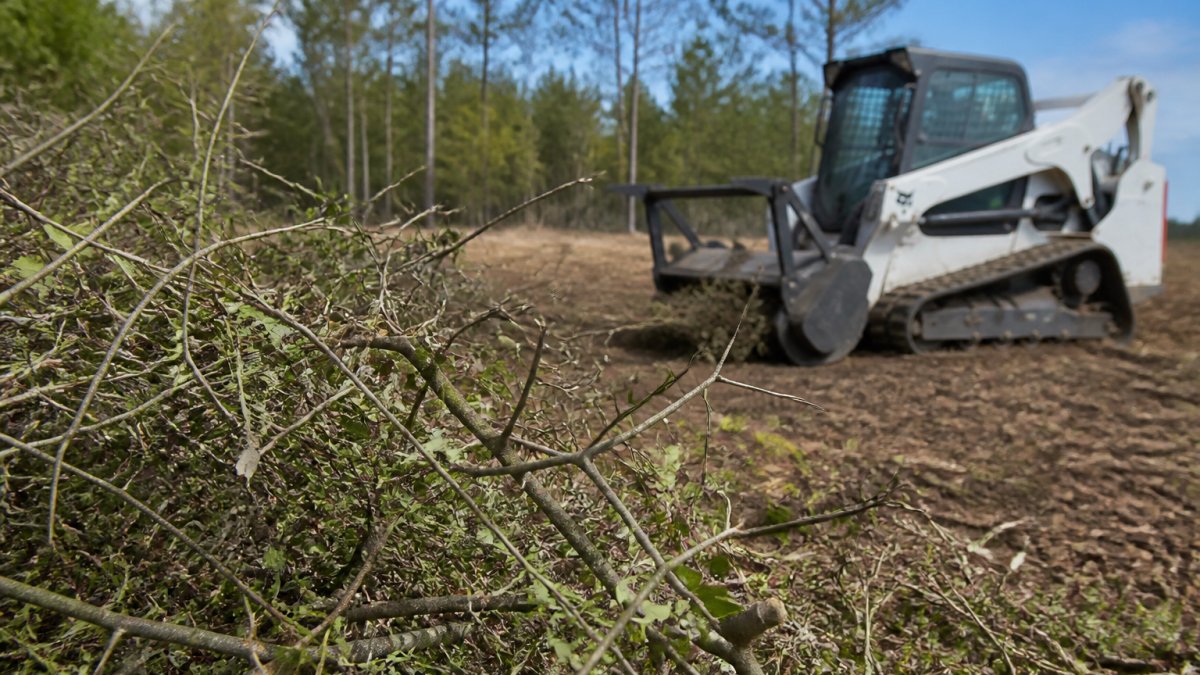
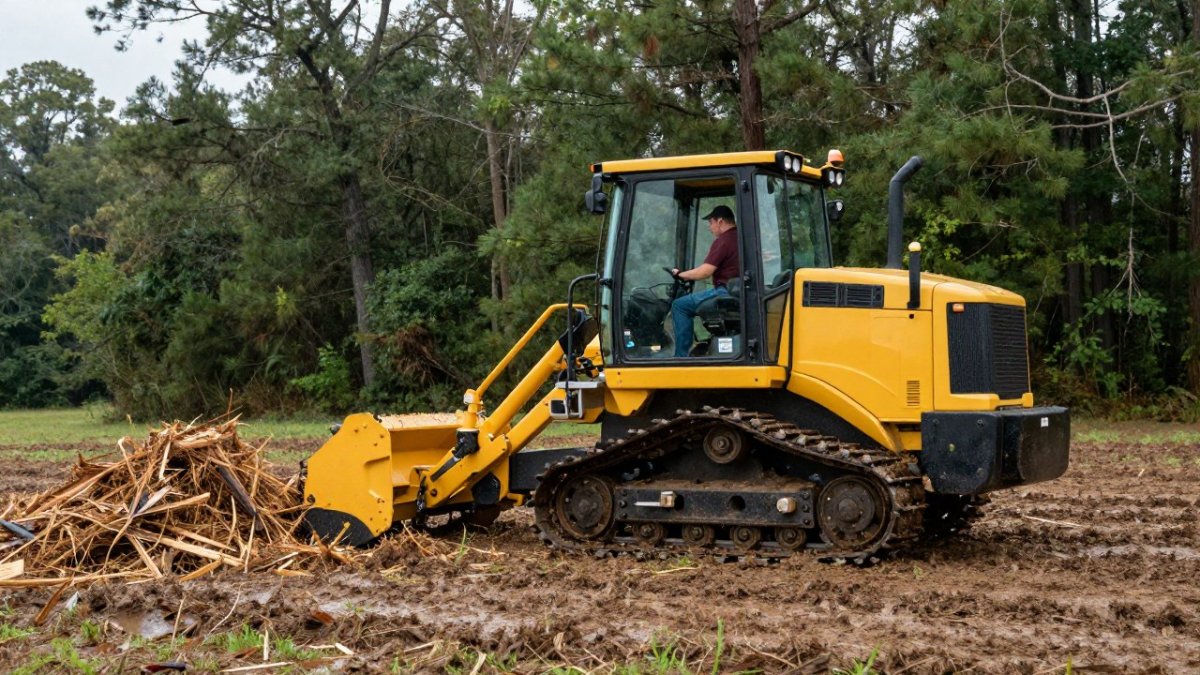
Ground pressure is the number that matters. A tracked machine spreads its weight over a larger footprint than a wheeled machine of similar size, which usually lowers ground pressure and reduces rutting.
- Tracked machines (tracked skid steers, compact track loaders, tracked excavators) generally perform better on soft ground because the tracks distribute load and grip without digging in as sharply as tires.
- Wheeled machines (wheel loaders, backhoes, dump trucks) concentrate weight on four contact points and tend to rut sooner, especially when loaded.
- Low-ground-pressure options such as wide-track machines, flotation tires, and purpose-built low-ground-pressure equipment can further reduce sinkage, but they still cannot overcome saturated subsoil.
Match the machine to the ground, and keep the heaviest loads on the driest, most stable routes. If the only access route crosses a wet low spot, consider temporary mats or a different entrance before moving equipment.
Inspecting the Route and Staging Area
A route inspection is not a glance from the truck. Walk it in the order equipment will travel and check each segment:
- Entrance and gate: Is the approach firm? Are there soft shoulders or existing ruts that will deepen under load?
- Driveway and culverts: Do culverts flow freely, or is water backing up and saturating the roadbed?
- Low crossings: Any dip that holds water is a candidate for temporary mats or an alternate route.
Watch out: staging debris on soft ground near the work area is a common cause of rutting that gets blamed on the clearing itself. Put piles on the highest, best-drained ground and keep them away from drainage paths.
Reducing Ground Disturbance Before Equipment Enters
Small choices before the first track rolls can save expensive repair later:
- Limit the number of machine passes over the same route.
- Keep the disturbed area as small as the job allows.
- Use temporary mats or a graveled entrance where the route is marginal.
- Schedule the heaviest equipment for the driest part of the day or the driest stretch of weather.
These steps do not replace a go/no-go decision, but they reduce the chance that a workable site becomes a rutted one.
Erosion and Sediment Control During Land Clearing
Bare soil plus rain equals erosion. Once vegetation removal strips the surface cover, runoff picks up speed and carries soil into ditches, streams, and neighboring property.
A 2018 study in Environmental Research Letters found that increasing land clearing, even with best management strategies in place, led to unsustainable levels of soil erosion.
Plan for sediment control before the first cut:
- Leave a buffer of vegetation along waterways and property lines
- Install silt fence or sediment barriers downslope of disturbed ground
- Keep disturbed area as small as the job allows
- Seed or mulch bare ground as soon as work stops
On sloped ground, water moves fast. Check barriers after every storm and clear them before they fail.
Partial Work or Full Postponement: A Go/No-Go Decision
Split the decision by zone. Rarely is an entire property too wet. Usually one low corner is the problem.
Use this simple decision path:
| Condition | Decision | Why |
|---|---|---|
| Ball test crumbles, no rutting underfoot | Full go | Ground can carry equipment |
| Dry upland, saturated low area | Partial work | Clear dry zones, hold wet ones |
| Soil smears, boots sink, standing water | Postpone | Compaction and rutting risk is high |
| Rain forecast within 48 hours | Postpone | Fresh disturbance plus rain means erosion |
| Recent deep rutting from prior work | Postpone and repair | Fix damage before adding more |
A 2022 study indexed by PubMed Central reports that the area impacted by soil erosion from construction activity grew by 61.6 thousand square kilometers. The scope of that figure is not U.S.-specific, but the direction is clear: ground disturbance and erosion travel together.
Watch out: starting "just a little" work in a wet corner is how most rutting claims begin. If the low ground fails the ball test, leave it alone.
Schedule a Wet-Soil Site Assessment With Palmetto Mulching & Clearing
Wet ground does not have to stall your project.
Palmetto Mulching & Clearing, LLC is an SBA Certified Veteran Owned Business, owned and operated by a retired Marine Corps veteran.
We have mulched 478 acres, cleared 139 acres, and built 15 ponds.
Wet soil rewards patience and punishes hurry. Get the ground checked by people who read it for a living.
Frequently Asked Questions
Can you clear land when the soil is wet?
Sometimes, but only after a site check. Clearing should happen when soil moisture is low enough that structural damage and compaction are minimized. On wet ground, tracked equipment can rut deeply and bury debris, so most crews test the soil first and either work a limited area or reschedule.
How long does soil take to dry after rain before heavy equipment can return?
There is no universal number. Clay and poorly drained soil can hold moisture for days after the surface looks dry, while sandy, sloped ground may dry faster. Check moisture below the surface, not just at the entrance, and reassess after every significant rain rather than relying on a fixed waiting period.
What happens if heavy equipment works on wet soil?
Compaction and rutting are the main risks. Pushing on saturated ground can cause deep rutting and buries debris, which complicates cleanup. Compacted layers restrict water and root movement, so the damage can outlast the project.
Is forestry mulching suitable for wet ground?
It depends on the machine and the moisture level. Tracked forestry mulchers spread weight over a wider footprint than wheeled equipment, which lowers ground pressure, but they can still rut saturated clay. Ask any contractor to walk the route and test the soil before committing, and expect some areas to be deferred until conditions improve.