 How-to
How to Find Affordable Bush Hogging Services in Georgia
Quick Summary
Affordable bush hogging services in Georgia are priced by acreage, vegetation density, terrain and access, so there is no single fixed rate. Compare quotes on the same terms, checking whether the price is per acre or a flat minimum, whether travel fees apply, and how many passes are included. Requesting written quotes from several providers is the most reliable way to find a fair price.
- Confirm whether a quote is per acre or a flat per-visit minimum, since minimums often set the real cost.
- Ask whether travel, setup or fuel fees are billed separately from the per-acre rate.
- Thick growth may need a second pass, so confirm how many passes the quote includes.
- Clarify whether the quote covers cutting only or also debris cleanup.
- Ask for a certificate of insurance before work starts.
Table of Contents
- What Bush Hogging Costs in Georgia Today
- Factors That Move Your Bush Hogging Cost Estimate
- Step 1: Assess Your Land Before Requesting Quotes
- Step 2: Compare Quotes and Confirm What Is Included
- Step 3: Prepare the Property and Check Safety and Liability
- Bush Hogging for Overgrown Fields: When It Fits and When It Does Not
- Booking Your Bush Hogging Visit with Palmetto Mulching & Clearing
- Frequently Asked Questions
What Bush Hogging Costs in Georgia Today
Last Updated: November 12, 2026
If you are looking for affordable bush hogging services in Georgia, pricing depends on acreage, vegetation density, terrain and access. For a firm price, request a quote from Palmetto Mulching & Clearing, LLC through our website. Bush hogging, also called brush hogging, uses a tractor-mounted rotary mower to cut tall grass, weeds and light brush across a field. Prices move with terrain, vegetation density and how many passes the job needs, so the per-acre range is only a starting point.
Published per-acre ranges
Per-acre pricing is the most common way providers quote. It works well for large open fields, where the crew can cover ground at a steady pace. For a small lot, the per-acre number can look low, but the minimum charge often sets the real cost.
Minimum charges and per-visit fees
Many providers set a minimum charge per visit. Travel distance, setup time and equipment transport can also add to the bill. If you have only a few acres, ask whether the quote is per acre or a flat minimum, and whether any travel fee applies. Those two questions often explain more of the price difference than the per-acre rate itself.
The article notes that per-acre rates can look low, while minimum charges often set the real cost. The table below summarises the cost-driving questions to ask before comparing quotes.
| Cost item | What to ask | Why it matters |
|---|---|---|
| Per-acre rate | Is the quote per acre or a flat minimum? | Per-acre pricing can look low on small lots |
| Minimum charge | What is the per-visit minimum? | Often sets the real cost on a few acres |
| Travel fee | Is any travel or setup charge billed? | Adds to the bill beyond the per-acre rate |
| Number of passes | How many passes does the quote include? | Thick growth may need a second pass |
| Debris cleanup | Does the quote include raking or hauling? | Cutting only costs less than cutting plus cleanup |
| Difficult terrain | Is there a surcharge for slopes or rocks? | Steep, wet or rocky ground can raise the quote |
Factors That Move Your Bush Hogging Cost Estimate
Several conditions push a quote up or down, and understanding them is what lets you tell a genuinely affordable bid from a cheap one that will cost more later. The biggest driver is vegetation. Tall grass and light weeds are the easiest work for a rotary cutter. Dense brush, briars and woody growth take more passes and slow the machine.
Terrain comes next. Level, open ground lets the crew work quickly. Steep slopes, ditches, rocks, stumps and soft or wet ground all slow the work and can create safety concerns for the equipment.
Acreage and access matter too. A long, narrow property may cost more per acre than a square one of the same size, because the machine spends more time turning. Gates, fences and tight access points can add time.
Sample estimates by property size
To make the ranges concrete, here are three illustrative scenarios built from the published Georgia figures above. These are planning examples, not quotes, and the assumptions matter as much as the numbers.
- Small residential lot, about 1 to 2 acres, light growth, level ground. The per-acre rate may matter less here because a minimum charge can dominate. Ask providers for their minimum charge and whether it covers the whole lot or only part of it.
- Mid-size field, about 10 acres, moderate grass and weeds, one pass. Costs for a field this size depend on density and terrain. A second pass for thicker patches adds cost, so confirm how many passes the quote includes.
- Larger overgrown acreage, 20-plus acres with tall grass and saplings. Heavier growth generally requires more passes or a different method. At this size, ask for a per-acre rate with a stated pass count rather than a single lump sum.
The line items that change the total
Beyond vegetation and terrain, watch for these add-ons when you compare bids:
- Travel and mobilization fees. Equipment transport has a real cost, and a distant provider may fold it into the per-acre rate or bill it separately.
- Minimum charges. Many providers set a per-visit minimum. A low per-acre rate with a high minimum can cost more than a higher rate with no minimum.
- Number of passes. One pass is not the same as two. Thick growth often needs a second cut, and the quote should say so.
- Debris and cleanup. Cutting only is cheaper than cutting plus raking or hauling. Confirm which one you are buying.
- Difficult-terrain surcharges. Steep slopes, wet ground and rock-strewn fields may carry an extra charge or be refused outright.
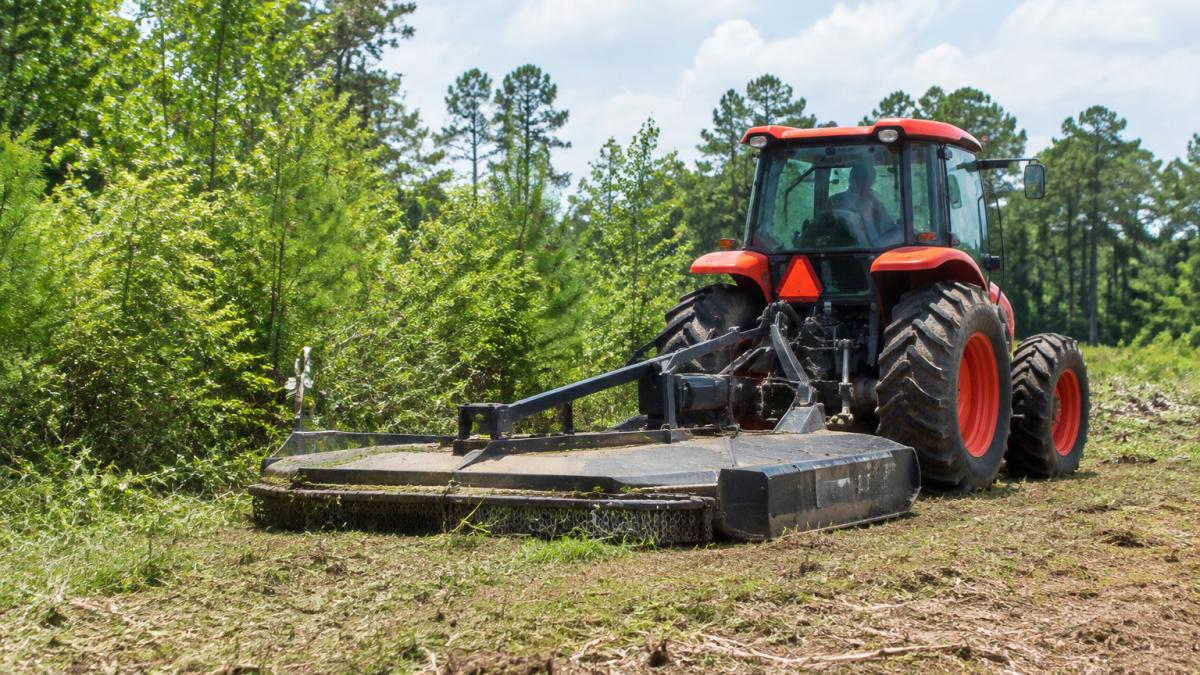
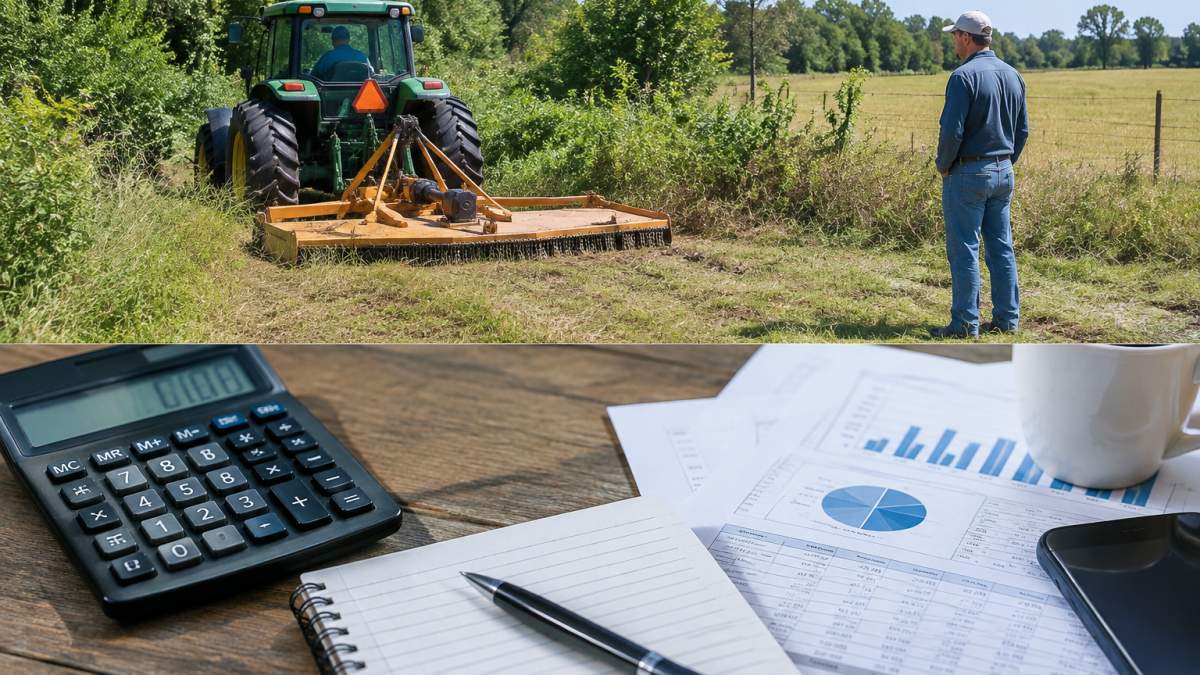
!A tractor with a rotary brush cutter mowing through tall, dense brush at the edge of a rural pasture in Georgia, with a landowner standing nearby reviewing the field
Step 1: Assess Your Land Before Requesting Quotes
Walk the property before you call anyone. Note the approximate acreage, the height and density of the growth, and whether there are saplings, stumps or rocks. Photograph the worst areas. Those photos help providers give an accurate estimate without a long site visit.
Check the ground condition too. Wet or soft soil can make heavy equipment rut the field and cause damage that outlasts the clearing. Our team at Palmetto Mulching & Clearing, LLC can review your site conditions when you request an estimate; you can read more about how wet soil affects clearing work on our page how to clear land on wet soil without causing damage.
Finally, mark property lines, underground utilities and any areas you want left alone, such as a pond edge or a garden. Clear boundaries prevent disputes and keep the work on target.
Step 2: Compare Quotes and Confirm What Is Included
Request at least two or three written quotes. Compare them on the same terms, not just the headline number. Ask each provider to state the acreage they are pricing, whether the price is per acre or a flat minimum, and whether travel, fuel or disposal fees apply.
Confirm the scope in writing. A low quote may cover only one pass, while a higher one may include a second pass for thicker areas. Ask whether the quote covers cutting only, or also includes debris cleanup. Ask who is responsible if the equipment damages a fence, a driveway or a neighbor's property, and whether the provider carries liability insurance.
Watch for quotes that are much lower than the others. They may reflect a missing minimum charge, an unstated travel fee, or a plan that will not actually clear your growth.
Step 3: Prepare the Property and Check Safety and Liability
Before the crew arrives, remove loose objects such as hoses, toys, lumber and metal debris from the field. A rotary cutter can throw rocks and debris, so keep people and pets clear of the work area. Mark any hidden hazards like irrigation lines, wells or shallow utilities.
Confirm the provider's liability coverage in writing before work starts. Ask for a copy of the certificate of insurance. If you are unsure what your own policy covers, a call to your insurance agent is worth the time.
Watch out: the most common costly mistake is skipping the boundary check. A provider can only avoid your fence or a buried line if you point it out first.
Bush Hogging for Overgrown Fields: When It Fits and When It Does Not
Bush hogging suits tall grass, weeds, light brush and open pasture. It is a fast method for keeping a field under control, especially when the growth is not woody. It is less suited to thick saplings, dense understory or ground with many stumps. The decision usually comes down to four questions: how dense the vegetation is, what finish you want, what should happen to the debris, and what your budget allows.
Bush hogging versus forestry mulching and other clearing methods
- Vegetation density. If the growth is mostly grass and weeds with scattered light brush, a rotary cutter handles it. If you are facing saplings over 2 to 3 inches, dense understory or matted woody growth, a bush hog will stall or leave stubble, and forestry mulching is the better fit.
- Desired finish. Bush hogging leaves cut stems and clippings on the ground. It looks mowed but not cleared. Forestry mulching grinds vegetation into mulch in one pass and leaves a smoother, more finished surface, which is why it usually costs more.
- Debris handling. A bush hog leaves cut material where it falls. Mulching reduces woody growth to chips in place, which can be an advantage on sites where hauling debris off would be expensive.
- Budget. Pricing for bush hogging and forestry mulching depends on the site, so request quotes for each method if you are unsure which one fits.
A practical rule of thumb: if you can walk the field and see over the growth, a bush hog is probably enough. If you cannot see the ground and the stems are woody, price forestry mulching before you book a mower.
Seasonal timing and regrowth management
Timing affects both the result and the cost. Mowing before weeds set seed can reduce regrowth, and a second pass later in the season often keeps a field tidy.
Regrowth is the part most quotes do not address. A single cut knocks back top growth but does not kill woody roots, so brush and saplings can return. If your goal is long-term control rather than a one-time cleanup, ask the provider how often the field will need maintenance and whether a second pass in the same season is included or billed separately.
Other providers may recommend different methods for the same site. Ask each one why they chose their approach for your land, and compare the reasons, not just the price.
Booking Your Bush Hogging Visit with Palmetto Mulching & Clearing
If your field is open, your growth is light to moderate, and your acreage fits a bush hogging job, Palmetto Mulching & Clearing, LLC can give you a clear per-acre or minimum-charge quote. Our owner is a retired Marine Corps veteran, and the business is an SBA certified veteran-owned company serving North Carolina, South Carolina and Georgia. Visit our website to request an estimate, and we will confirm the scope and insurance details before any work begins.
Frequently Asked Questions
What is the average rate for bush hogging?
Pricing depends on the provider, acreage, terrain and vegetation density. Request a quote for your property to get a firm price. Terrain, vegetation density, and access all affect where a job lands in that range. Confirm the final price in writing before work begins.
How much does bush hogging cost per acre in Georgia?
Bush hogging prices vary by site, so request a quote for your property. Lighter grass and brush on level ground usually sit at the low end, while tall, overgrown fields with saplings sit higher. Ask each provider whether their quote is per acre or per hour, and whether a minimum charge or travel fee applies to your property.
What factors affect the cost of bush hogging?
The main drivers are acreage, vegetation density, terrain, and access. Saplings over 2 to 3 inches generally call for a different clearing method, which can change the price or whether bush hogging is the right service at all. Wet ground, rocks, stumps, and tight gates also slow the work. Clear information about these conditions helps you get a quote that reflects your actual site.
What should I ask a bush hogging contractor before hiring?
Ask whether the quote is per acre or per hour, what the minimum charge is, and whether travel fees apply. Confirm the cutting height, whether debris is left on the ground, and whether the crew carries liability insurance that covers damage to fences or neighboring property. Request the quote in writing so you can compare providers on the same terms.