 Ultimate guide
Pond Construction and Site Preparation: The Essential Guide
Last Updated: November 17, 2026
Quick Summary
Successful pond construction depends on site preparation, because the site largely decides the outcome of a pond project. A one-acre pond typically needs 10 to 15 acres of surface drainage to fill and stay full, and the wrong location cannot be fixed by construction techniques. Test soil for clay content and permeability before you commit.
- A one-acre pond typically needs 10 to 15 acres of surface drainage to fill and stay full.
- Strip topsoil first and stockpile it separately for future vegetative cover on the embankment.
- Recommended average depth is 6 to 8 feet, with a maximum of 10 to 12 feet.
- Lay about 6 inches of soil to achieve a 4-inch compacted base.
- A mid-sized pond averages $7,400 nationally, with larger ponds at $6,700 to $17,735 per acre.
Table of Contents
- Why Site Preparation Decides Whether Your Pond Holds Water
- Pond Site Selection and Soil Testing: The Step That Cannot Be Fixed Later
- Land Clearing, Topsoil Stripping, and Stockpiling
- Pond Excavation and Grading: Building the Basin and Embankment
- Pond Permits and Regulations: What to Check Before You Break Ground
- Pond Construction Cost: What Drives the Number
- Spillways, Outlets, and Erosion Control That Protect the Investment
- Climate-Resilient and Low-Maintenance Design Choices
- Frequently Asked Questions
Why Site Preparation Decides Whether Your Pond Holds Water
A pond that fails almost always fails before the first bucket of soil is moved. According to the Kentucky Department of Fish and Wildlife Resources pond management guidance, a one-acre pond typically needs 10 to 15 acres of surface drainage to fill and stay full.
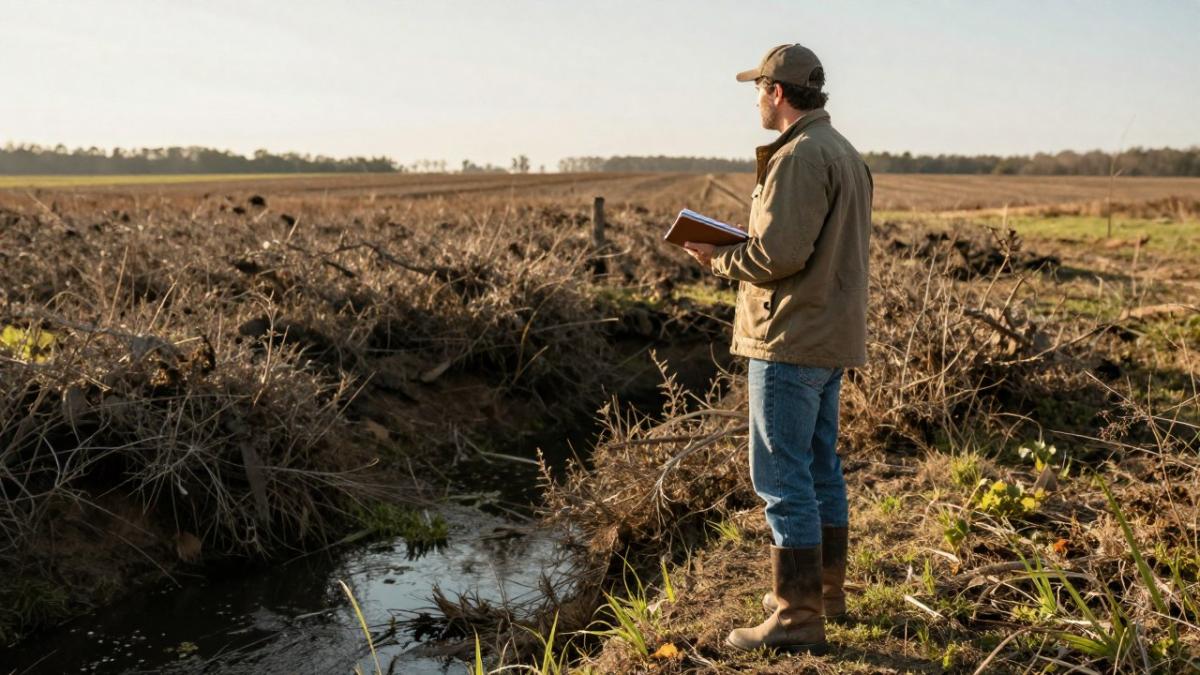
Pond Site Selection and Soil Testing: The Step That Cannot Be Fixed Later
Site selection is the one phase no amount of construction skill can rescue. The Alabama Cooperative Extension System guidance on pond sites is blunt: choosing the wrong location cannot be fixed by construction techniques, making preliminary site studies the most vital phase of the project. Walk the property first. Look for a natural depression, reliable drainage, and soil that holds water.
Reading the Watershed: How Much Drainage You Need
Watershed is the land area that drains into your pond. Too little and the pond never fills; too much and your spillway gets overwhelmed. The 10-to-15-acre rule above is the working benchmark for a one-acre pond.
Soil Testing for Clay Content and Permeability
Clay content and permeability decide whether water stays. Texas A&M AgriLife Extension's soil considerations for ponds emphasizes that soil selection is of major importance in reducing labor and expense. Have a geotechnical survey done before you commit.
| Site Factor | Target | Why It Matters |
|---|---|---|
| Watershed area | 10-15 acres per pond acre | Fills and maintains water level |
| Soil type | High clay content, low permeability | Prevents seepage |
| Average depth | 6-8 feet | Supports fish and water quality |
| Minimum depth zone | 8 feet over ~1,000 sq ft | Winter survival, best management |
| Maximum depth | 10-12 feet | Avoids steep, unstable banks |
Land Clearing, Topsoil Stripping, and Stockpiling
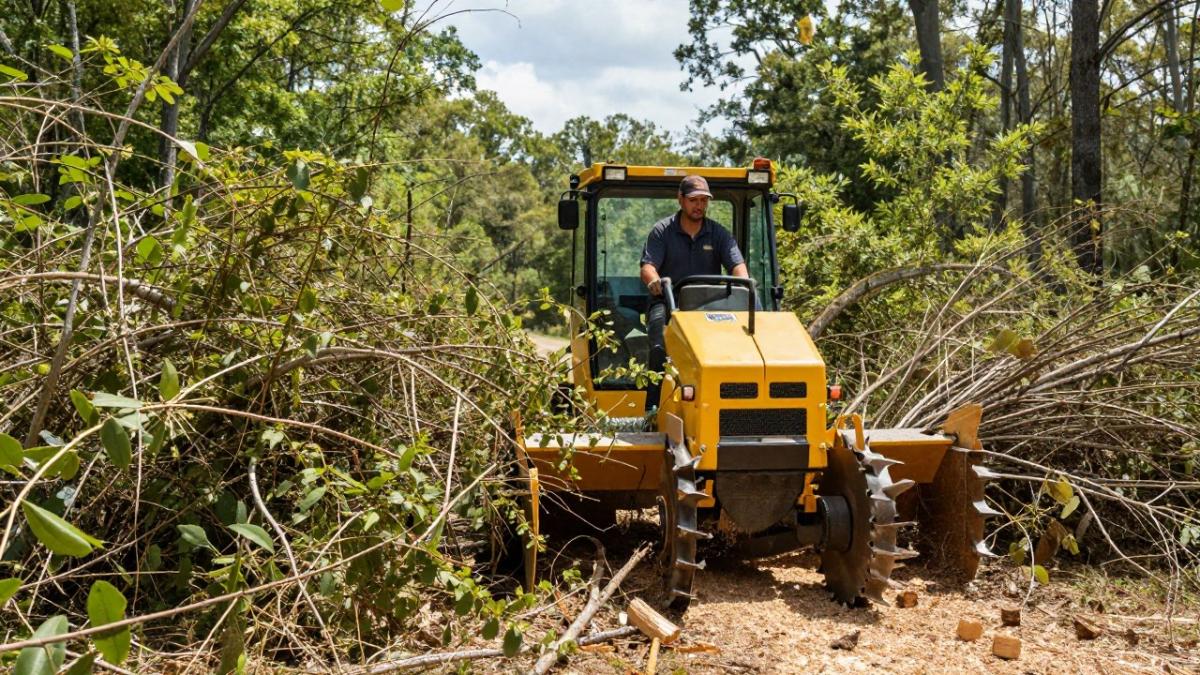
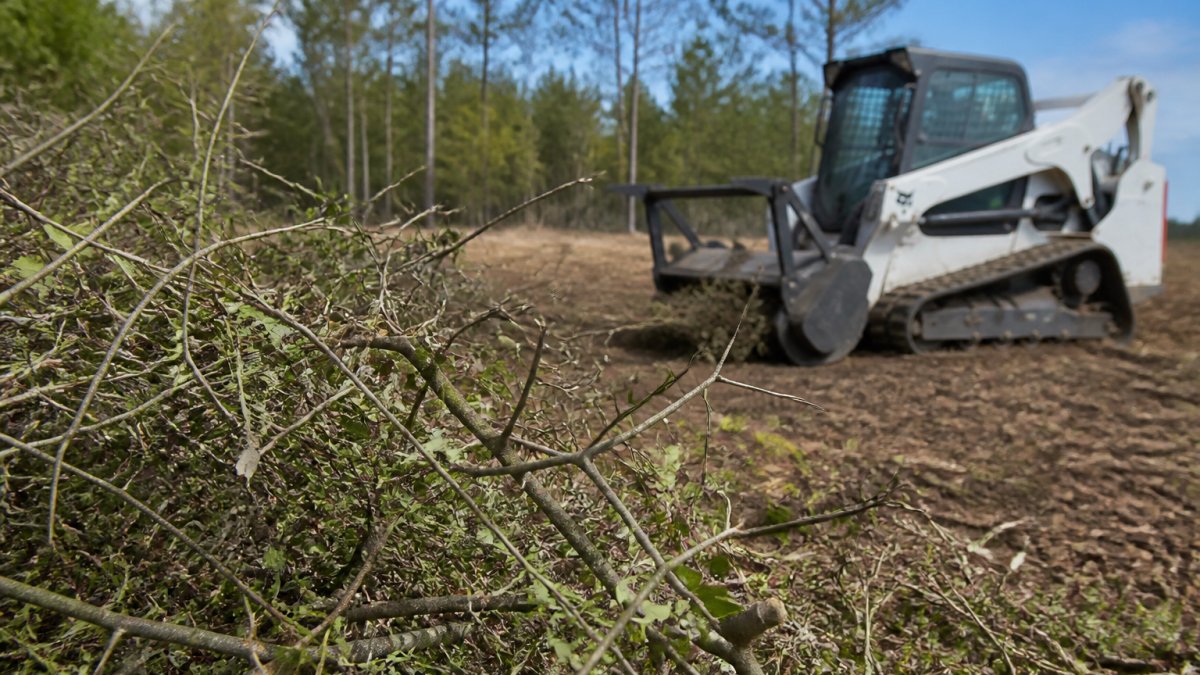
Land clearing comes next, and it is where the schedule usually slips. If your pond site holds wet ground, our guide to clearing land on wet soil without causing damage covers the equipment and timing that keep a saturated site from turning into a mud pit, and our breakdown of how long land clearing takes by acre and method gives you a realistic timeline.
Strip topsoil first and stockpile it separately. That organic layer is your future vegetative cover on the embankment, and burying it in the basin wastes both the soil and the money you spent moving it.
Pond Excavation and Grading: Building the Basin and Embankment
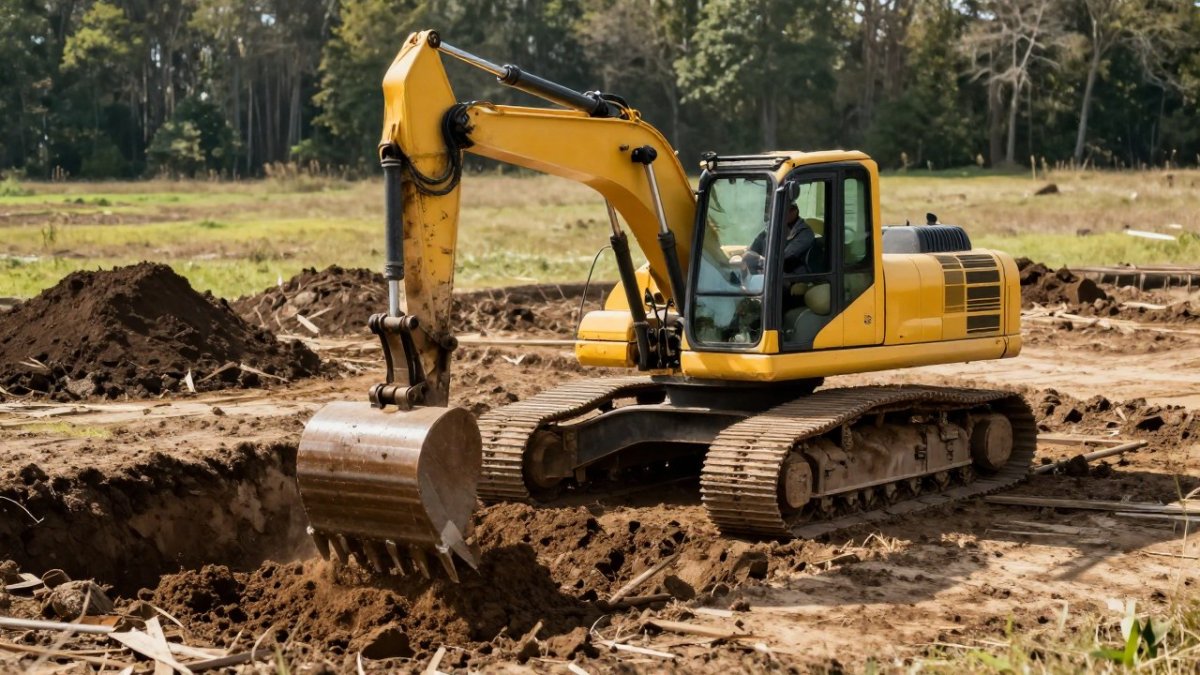
Excavation builds the basin and the embankment that holds the water. Excavation and grading follow a sequence of machine work to shape the banks. Get this phase wrong and you inherit seepage and slope stability problems for the life of the pond.
Depth, Compaction, and Slope Stability
The New York State Department of Environmental Conservation pond construction guidance recommends a minimum depth of 8 feet over roughly 1,000 square feet for best management. The Virginia Department of Wildlife Resources pond construction standards calls for an average depth of 6 to 8 feet, with a maximum of 10 to 12 feet. Compaction is not optional: CABI's technical standard for pond floor preparation describes laying about 6 inches of soil to achieve a 4-inch compacted base. Skipping compaction invites seepage straight through the embankment.
Pond Permits and Regulations: What to Check Before You Break Ground
Permitting is where a pond project quietly loses a season. The triggers are not intuitive: a pond dug in an upland pasture may need almost nothing, while one in a drainageway, wetland, or stream corridor can require federal, state, and local approvals that stack on top of each other. The order you pursue them in matters as much as the permits themselves.
The Federal Triggers Most Landowners Miss
Three federal programs catch most pond projects that touch water or wetlands:
- Section 404 of the Clean Water Act. If any dredged or fill material, including excavated spoil, is placed into waters of the United States, including many wetlands, a permit from the U.S. Army Corps of Engineers is generally required. Nationwide Permits cover some small, low-impact activities, but acreage limits and notification requirements vary by permit and district, so confirm with the Corps district office before you clear.
- Section 10 of the Rivers and Harbors Act. Work in, over, or under navigable waters of the United States requires Corps authorization, and 'navigable' is broader than most people assume.
- Endangered Species Act consultation. If a listed species or critical habitat is present, the Corps permit process triggers consultation with the U.S. Fish and Wildlife Service or NOAA Fisheries, the step that most often extends timelines by months.
A pond built entirely in upland with no wetland or stream connection usually avoids all three; one built in a wet meadow, seasonal drainage, or floodplain usually does not. That distinction is worth a consultant site visit before you buy a single permit application.
State Dam Safety and Water Rights Rules
Most states regulate embankment dams above a height or impounded-volume threshold, commonly around 25 feet of height or 50 acre-feet of storage, though exact numbers are set state by state.
Water rights are a separate question. In prior-appropriation states, storing water off a stream, even on your own land, can require a storage permit or water right.
Local, County, and Conservation District Requirements
County and municipal rules are where schedules actually slip, because they are the least standardized:
- Erosion and sediment control permits for any disturbed area above a local threshold, often paired with a stormwater pollution prevention plan.
- Floodplain development permits if any part of the embankment or basin lies in a mapped floodplain.
- Zoning and setback rules that may push the pond away from property lines, wells, septic systems, or road rights-of-way.
A practical sequence: start with the county planning office to map every local trigger, then the state environmental agency for dam safety and water rights, then the Corps district for the federal question.
Watch out: a pond built without required approvals can be ordered drained or rebuilt at the owner's expense, and in wetland cases the restoration obligation can exceed the original construction cost.
What Permitting Does to Your Budget and Schedule
Permitting is a line item, not a formality. Application fees vary widely by jurisdiction, and the larger cost is usually the professional work, wetland delineations, engineered dam plans, and consultant time, plus the delay itself. A project needing only a local erosion permit may clear in a few weeks; one that triggers Corps review with species consultation can run six months or more.
Pond Construction Cost: What Drives the Number
Pond construction cost tracks three variables: size, site difficulty, and haul distance for spoil. A mid-sized pond averages $7,400 nationally, while larger farm ponds and artificial lakes run $6,700 to $17,735 per acre (Daniel Dean, 2026). Wet ground, heavy brush, and long access routes push those numbers up. Pricing depends on your specific site conditions, so get a quote from Palmetto Mulching & Clearing, LLC for current pricing.
Spillways, Outlets, and Erosion Control That Protect the Investment
Most pond failures are not wall failures, they are spillway failures. When the emergency overflow is undersized or unlined, a heavy rain event sends water around the embankment instead of through it, and the resulting headcut can breach a dam in hours. Site preparation decisions made months earlier determine whether the pond survives its first big storm.
Principal and Emergency Spillways: Two Different Jobs
A well-designed pond has two overflow paths, and they are not interchangeable:
- The principal spillway carries normal flows, the routine runoff that arrives most years. It is usually a pipe through the embankment with a riser structure at the upstream end, sized to pass the expected flow without the water level reaching the emergency spillway.
- The emergency spillway is the backup: a vegetated or armored channel cut into undisturbed ground at one end of the embankment, set at an elevation that lets extreme flows pass without overtopping the dam. It should never be the primary path, and it should never be cut through fill.
Sizing both depends on the watershed area, the rainfall intensity for your region, and the pond's storage volume. A common pattern is to size the principal spillway for a storm with a return period of several years and the emergency spillway for a much rarer event, the exact return periods are set by state dam safety rules where they apply, and by engineering judgment where they do not.
Outlet Structures and Drawdown Capability
An outlet is more than a drain, it is a management tool. A properly designed outlet lets you:
- Draw down the pond for repairs, vegetation control, or fish management without pumping.
- Control the water level seasonally, which matters for both water quality and bank stability.
- Release water from the bottom of the pond, where temperatures are cooler and oxygen levels are lower, which can improve downstream water quality.
Common outlet types include a riser-and-barrel system, a drop-inlet structure, and a siphon system for ponds where a through-embankment pipe is impractical. Each has trade-offs in cost, maintenance access, and failure mode.
Watch out: an outlet pipe through the embankment is a seepage path if the backfill around it is not compacted in lifts and sealed with an anti-seep collar, one of the most common causes of embankment failure.
Erosion Control That Actually Holds
Bare soil around a new pond erodes fast, and the sediment ends up in the basin you just paid to dig. Erosion control on a pond site works in layers:
- Temporary stabilization during construction: silt fence, straw wattles, and temporary seeding on stockpiles and disturbed areas, sized to local erosion and sediment control requirements.
- Permanent vegetative cover on the embankment and around the inlet and outlet: deep-rooted grasses that hold soil through wet and dry cycles. Vegetation on the embankment is the cheapest long-term protection available, but it has to be established before the first big rain, not after.
- Armoring at concentrated flow points: riprap or equivalent protection where the emergency spillway, outlet, and any concentrated inflow enter or leave the pond. Vegetation alone will not survive concentrated flow.
Designing for Lower Maintenance From Day One
This is where site preparation and long-term cost meet. A few decisions made during construction reduce maintenance for the life of the pond:
- Leave equipment access to the spillway and outlet. If you cannot reach them with a truck or small excavator, inspections get deferred and small problems become large ones.
- Keep a vegetated buffer around the pond rather than mowing to the water's edge. The buffer filters sediment and nutrients before they reach the basin, which slows the fill rate that eventually requires dredging.
- Design the spillway so it can be inspected from dry ground. A spillway you can only see from the water is a spillway that gets checked rarely.
The pattern is consistent: the ponds that cost the least to own are the ones where the spillway, outlet, and vegetative cover were designed together during site preparation, not added after the embankment was already built.
Climate-Resilient and Low-Maintenance Design Choices
Design for the weather you actually get, not the average year. Size the spillway for heavy rain events, build banks at a stable slope, and plan vegetative cover that holds soil through dry spells. A bentonite liner is worth discussing with your contractor if soil testing shows marginal clay content.
A pond that holds water starts with a site that was read correctly.
Frequently Asked Questions
What are the steps of pond preparation?
Site preparation runs in a fixed order: site selection and a geotechnical survey, soil testing for clay content, land clearing and grubbing, topsoil stripping and stockpiling, excavation and grading of the basin and embankment, compaction in lifts, then spillway and outlet installation. Each phase depends on the one before it. Stripping topsoil before excavation, for example, keeps that material available for later vegetative cover on the embankment, which is what controls erosion once the pond fills.
What is the average cost to build a pond?
Pond construction cost depends on size, site conditions, and access. Those figures cover excavation and construction, not the site work that comes first. Clearing, grading, and hauling add to the total, and pricing for that work depends on acreage, brush density, and access, so get a quote based on your specific property.
How deep should a half-acre pond be?
Virginia Department of Wildlife Resources recommends an average depth of 6 to 8 feet for fishing ponds, with a maximum of 10 to 12 feet. New York State DEC sets a minimum of 8 feet over roughly 1,000 square feet for best management. For a half-acre pond, that means most of the basin should sit in the 6 to 8 foot range with a deeper pocket. Shallow edges invite algae and weed growth, so keep the margin steep enough to limit sunlight reaching the bottom.
How do you choose the right site for a pond?
Start with the watershed. Kentucky Department of Fish and Wildlife Resources notes that 10 to 15 acres of surface drainage are typically needed to fill and maintain one acre of pond. Then test the soil: high clay content holds water, while sandy or gravelly ground leaks. Avoid floodplains, septic fields, and steep slopes that need heavy embankment work. The Alabama Cooperative Extension System makes the case that site selection matters more than construction technique, because a bad location cannot be fixed after the fact.
What soil is best for building a pond?
Soil with high clay content is the standard, because clay limits permeability and keeps water in the basin. Texas A&M AgriLife Extension emphasizes that soil selection is a major factor in reducing labor and expense, so test before you dig. Where native soil falls short, a liner may be an option to discuss with your contractor. A geotechnical survey tells you which route your site needs.
How big of a pond can I build without a permit?
There is no single national threshold. Pond permits and regulations are set at the state and county level and often hinge on pond size, dam height, and whether the site sits in a wetland or floodplain. Some jurisdictions exempt small ponds below a set surface acreage, while others require a permit for any dam impounding water. Contact your state environmental agency and county planning office before clearing land, and confirm whether a federal wetland determination applies to the site.
How long does it take to build a pond?
Timeline depends on size, access, and weather. A small residential pond on cleared, accessible ground can move from clearing to finished basin in a matter of days of machine time. Larger farm ponds and sites with dense brush, wet spots, or long haul distances take longer, and permitting can add weeks before equipment ever arrives. Build the permit phase into your schedule, especially if you need the pond finished before construction on the property starts.